

How CHEP measures savings.
Every shared-savings agreement is built on a verified, auditable measurement methodology. Here is how it works.
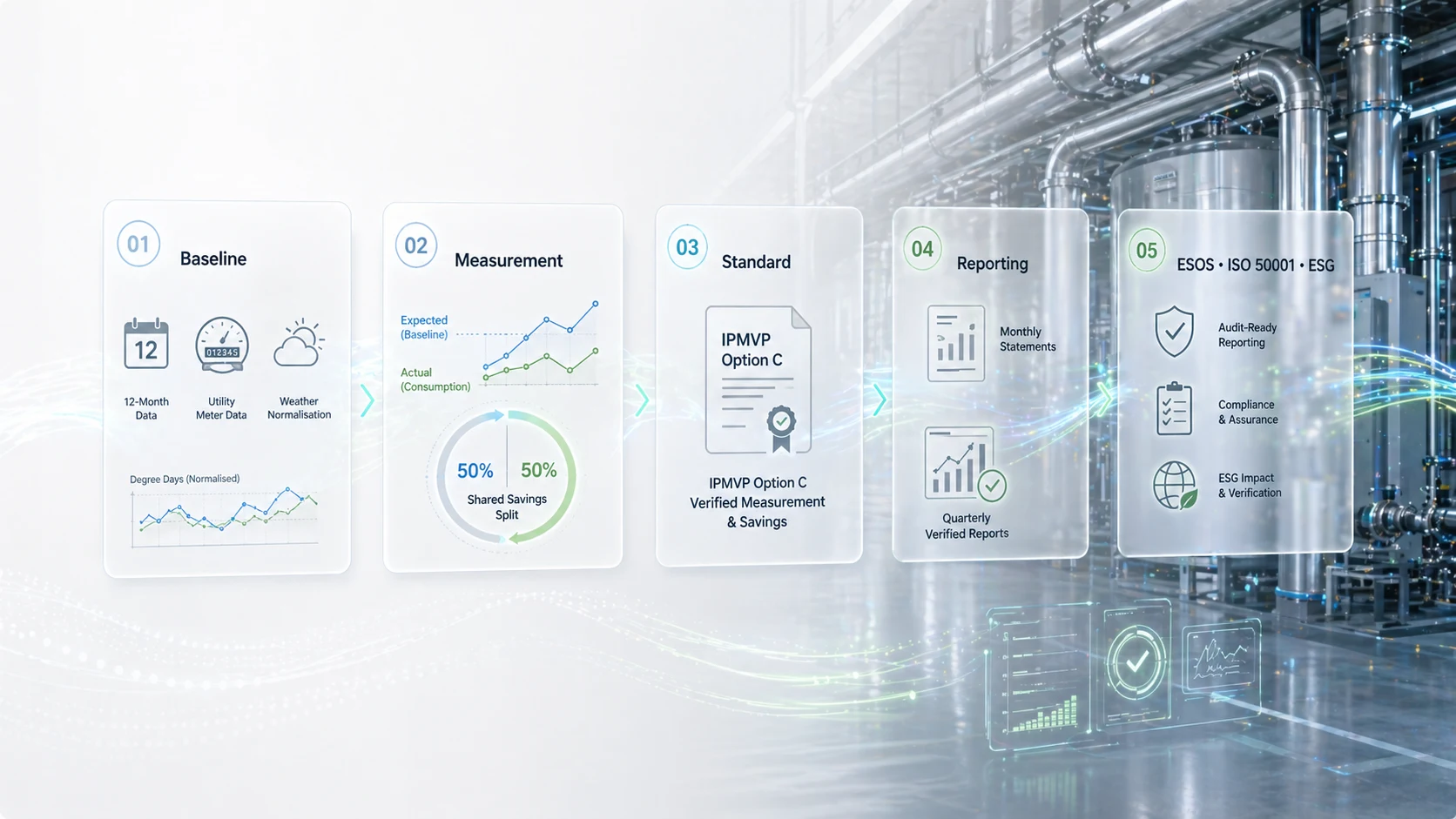
Five steps. One auditable chain of evidence.
From a verified 12-month baseline through to ESOS, ISO 50001 and ESG-ready reporting — every stage is documented, weather-normalised, and aligned with IPMVP Option C.
A verified, 12-month consumption baseline.
The starting point of any CHEP agreement is the baseline. We collect a minimum of 12 months of pre-install fuel consumption data from your meter, supplier statements, or half-hourly data feed. That period must include at least one full heating season.
The data is normalised against weather using regional heating degree-day data from BizEE, then expressed as a baseline consumption profile per degree-day. That profile becomes the reference against which all post-install consumption is compared.
What you sign before any install
Before commissioning, you receive and approve the written baseline document. Both parties countersign it. It cannot be altered after install.
Post-install consumption against a degree-day-adjusted forecast.
After commissioning, your fuel consumption is collected on the same cadence as the baseline. For each measurement period the methodology calculates the consumption that would have been expected from the baseline profile, given the actual degree-days for the period.
The verified saving is the difference between the expected consumption and the actual consumption, multiplied by your unit fuel rate for the period. Tariff changes are factored in so a fall in unit rate cannot be claimed as an efficiency saving, and a rise in unit rate cannot inflate it.
Adjustments we make
Heating-load changes (extension to the building, new occupancy pattern, additional plant) are recorded as baseline adjustments and re-baselined where material. The methodology is designed to leave neither party advantaged by changes outside the unit's control.
Aligned to IPMVP Option C.
The CHEP methodology aligns to the International Performance Measurement and Verification Protocol (IPMVP) Option C, the whole-facility utility-data approach used for retrofit measurement worldwide. Option C is the appropriate IPMVP method when a single conservation measure is installed and whole-building consumption is being tracked.
That alignment matters because IPMVP-aligned outputs are accepted by ESOS lead assessors, ISO 50001 certification bodies, and the major ESG reporting frameworks.
Monthly statements. Quarterly verified reports.
On the same day each month you receive a savings statement covering the previous period: actual consumption, expected consumption, verified saving, your 50% share, our 50% invoice line. The format is unchanged for the lifetime of the agreement.
Each quarter the monthly figures are consolidated into a verified report covering consumption trend, weather adjustment evidence, system status notes, and a sign-off page. That quarterly pack is the document you take into ESOS, ISO 50001, or ESG reporting.
If you dispute a figure
Either party can raise a query against any monthly or quarterly statement within 30 days. The methodology document specifies how data sources are checked, recalculations run, and adjustments issued. Unresolved disputes go to an independent IPMVP-certified measurement and verification professional, with cost split equally.
Reporting outputs your auditors will accept.
The verified consumption and savings data produced by the programme is suitable for inclusion in your ESOS Phase 4 submission as an implemented energy efficiency action, in your ISO 50001 energy management documentation, and in corporate ESG disclosures requiring auditable Scope 1 reduction evidence.
On request we provide a methodology pack you can supply to your lead ESOS assessor ahead of submission, covering baseline construction, measurement method, weather adjustment, and verification procedure.